Understand SARS timelines for deceased estates in South Africa, including delays, audits and how long the full process takes.
How Long Does a Deceased Estate Take? SARS Timelines Explained
One of the most common questions when dealing with a deceased estate is how long the process will take.
While the steps may seem straightforward, SARS timelines and administrative requirements can extend the overall process significantly. Understanding these timelines helps set realistic expectations and ensures better planning.
Typical SARS Timelines for Deceased Estates
The following are general timeframes for key stages in the process:
SARS notification: 2 to 4 weeks
Estate registration: 4 to 8 weeks
Return submissions: 21 to 60 working days
Verification or audits: 30 to 90 working days
Estate duty assessment: up to 1 year
Final compliance: 30 to 90 working days
These timelines may vary depending on the complexity of the estate and SARS processing times.
What Can Cause Delays?
Delays in deceased estate administration often occur due to:
Complex estate structures
Missing or incomplete documentation
SARS audits or verification processes
Historical tax issues
Ensuring that all documentation is accurate and complete can help minimise unnecessary delays.
How Long Does the Full Process Take?
While individual steps may appear manageable, the full deceased estate process typically takes time to complete.
Most deceased estates take between 6 and 18 months to finalise tax matters. More complex estates may take longer, particularly where additional audits or complications arise.
This is a structured, multi-step process that depends on SARS turnaround times, accurate documentation and careful coordination.
Why Professional Support Matters
Managing a deceased estate can be both complex and emotionally challenging. Early professional guidance can help reduce delays, ensure compliance and ease the administrative burden during a difficult time.
If you need assistance navigating a deceased estate, having the right support can make the process more efficient and less stressful.
A clear step-by-step guide to the deceased estate tax workflow in South Africa, including SARS processes, documents and compliance.
Once you understand what needs to be done, the next step is knowing how the process unfolds.
Deceased Estate Tax Workflow: Step-by-Step
Administering a deceased estate involves a structured series of steps, each with specific requirements, documentation and timelines. Understanding the process upfront can help prevent delays and ensure compliance with SARS requirements.
This guide provides a clear overview of the deceased estate tax workflow in South Africa.
1. Notify SARS of the Death
SARS must be formally notified of the death.
Required documents include:
Certified copy of the death certificate
Certified copy of the deceased’s ID
Certified copy of the executor’s ID
Letter of Executorship or Letter of Authority
Executor contact details
Proof of address
Result: SARS updates the taxpayer profile and links the executor to the estate.
2. Register the Deceased Estate
Income must be split between:
Income earned before death
Income earned after death
A new deceased estate tax reference number must be registered via eFiling.
3. Submit Outstanding Tax Returns
All outstanding tax returns up to the date of death must be submitted.
This includes:
Outstanding income tax returns
Final income tax return
Provisional tax, VAT and PAYE (if applicable)
Supporting documents may include:
IRP5 or IT3(a) certificates
Medical aid certificates
Retirement annuity certificates
Investment income statements
Rental income schedules
Financial statements (if a business is involved)
4. Capital Gains Tax (CGT)
At death, SARS treats assets as disposed of at market value. These deemed disposals may trigger Capital Gains Tax.
Common affected assets include:
Property
Investments
Business interests
Loan accounts
Required documents:
Property valuations (REV246)
Investment statements
Business valuations
Asset registers
Capital Gains Tax plays an important role in deceased estate administration, particularly where assets are deemed to be disposed of at market value. Learn more about Capital Gains Tax in South Africa → Capital Gains Tax
5. Estate Duty (If Applicable)
Estate duty applies if the estate exceeds the relevant threshold.
Required submissions:
Estate Duty return (REV267)
Liquidation and Distribution Account
Asset schedules
Supporting documents may include:
Bank statements
Property valuations
Investment statements
Life policies
Liability confirmations
6. Estate Income (After Death)
In many cases, a deceased estate income tax reference number must be registered where the estate continues to generate income.
Income earned must be apportioned between:
The period before death
The period after death
This ensures accurate reporting in both the final individual tax return and the deceased estate tax return.
Examples of income include:
Rental income
Interest
Dividends
Business income
7. SARS Compliance & Tax Clearance
Before the estate can be distributed:
All tax returns must be submitted
All taxes must be paid
Any SARS queries must be resolved
Final outcome:
SARS compliance confirmed The estate can be distribute
Bringing It All Together
Each step plays a critical role in ensuring that the estate is administered correctly and without unnecessary delays.
While the process is structured, timelines may vary depending on the complexity of the estate and SARS turnaround times.
When a person passes away, their tax obligations do not fall away. The administration of a deceased estate involves several SARS requirements that must be handled carefully and correctly.
Understanding what happens to tax affairs after death can help families and executors manage the process with clarity and confidence.
What Happens to Tax Affairs After Death?
All tax matters relating to the deceased must be finalised as part of the estate administration process.
This typically includes:
Final individual income tax return
Deceased estate income tax (if applicable)
Capital Gains Tax (CGT) on deemed disposals
Estate duty (if applicable)
SARS compliance and tax clearance
The executor of the estate is responsible for managing this entire process and ensuring that all obligations are met.
At a Glance
This guide provides an overview of:
The deceased estate tax process
Key supporting documents required
SARS timelines and turnaround times
What to expect from a tax perspective after death
Why This Process Matters
Administering the tax affairs of a deceased estate can be complex, particularly during an already difficult time.
Ensuring that all tax obligations are correctly handled is essential to avoid delays, penalties and complications in the distribution of the estate.
A Practical Next Step
Understanding what needs to be done is the first step. The next step is understanding how the process works in practice.
The South African Revenue Service (SARS) has announced an increase in the VAT registration thresholds as part of the 2026 National Budget. These changes affect when businesses are required or allowed to register for Value-Added Tax (VAT).
Understanding the updated thresholds is important to ensure compliance and avoid unnecessary penalties.
New VAT Registration Thresholds (Effective 1 April 2026)
From 1 April 2026, the following thresholds apply:
Compulsory VAT registration Taxable supplies exceeding R2.3 million in any 12-month period Previously R1 million until 31 March 2026
Voluntary VAT registration Taxable supplies exceeding R120 000 in any 12-month period Previously R50 000 until 31 March 2026
VAT Rate in South Africa
The standard VAT rate remains at 15 percent, effective since 1 April 2018.
What This Means for Your Business
The increase in thresholds means that fewer small businesses will be required to register for VAT. Businesses approaching the new threshold should monitor their turnover carefully to remain compliant. Voluntary registration remains an option for growing businesses that wish to register earlier.
VAT Registration Process Enhancements
SARS has also introduced improvements to the VAT registration process to provide greater clarity and efficiency for applicants.
Updated VAT notice of rejection With effect from 8 December 2025, SARS service consultants can select specific rejection reasons. Applicants will receive a customised notice clearly explaining why the application was declined.
Improved process for requesting supporting documents If additional or outstanding documents are required, SARS may contact applicants telephonically. In addition, a formal letter may be issued specifying the required documents. Applicants will have five business days to submit these documents. If the required documents are not submitted within this timeframe, the system will automatically reject the application and issue a notice of rejection.
Final Thoughts
These updates highlight the importance of staying informed about SARS requirements and maintaining accurate financial records.
If you are unsure whether your business should register for VAT or require assistance with compliance, professional guidance can help ensure that your obligations are met correctly.
Learn how provisional tax works in South Africa, including deadlines, penalties and the latest 2026 SARS updates on underestimation rules.
Provisional tax is an important part of the South African tax system for individuals and businesses earning income outside of a traditional salary. Understanding how it works, including deadlines and penalties, is essential to remain compliant with SARS requirements.
What is Provisional Tax?
Provisional tax applies to individuals who earn income other than a salary or standard remuneration from an employer. This includes income such as rental income, interest or income from a trade or small business.
If you earn non-salary income, you may be required to register as a provisional taxpayer, even if you also earn a salary.
Provisional tax is paid manually in advance, based on estimated taxable income for the year.
Provisional Tax Deadlines
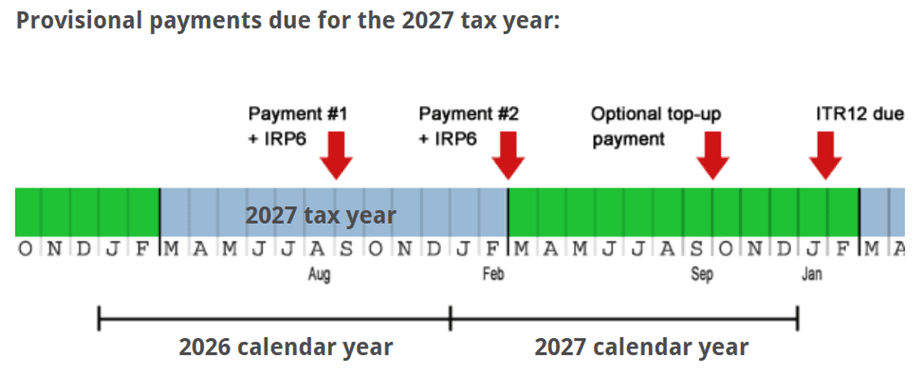
Provisional tax is paid in two compulsory instalments each year:
First payment Due by the end of August (mid tax year)
Second payment Due by the end of February (end of tax year)
Optional third payment Due by the end of September (seven months after the end of the tax year) This payment is only required if the first two payments were insufficient
Penalties for Late Payment and Underestimation
SARS may impose penalties in the following circumstances:
Late payment penalty A 10 percent penalty is charged on any late payment of provisional tax
Underestimation penalty A 20 percent penalty is charged if the estimated taxable income is significantly lower than the final assessed taxable income
With effect from 25 February 2026, failure to pay the estimated amount on time may also trigger the underestimation penalty
The 20 percent underestimation penalty is reduced by any late payment penalty already imposed. These penalties are applied in terms of section 213 of the Tax Administration Act
When Does the Underestimation Penalty Apply?
The underestimation penalty applies in the following cases:
For taxable income below R1 million If the estimate is less than 90 percent of the final assessed taxable income and less than the basic amount based on the most recent assessment
For taxable income above R1 million If the estimate is less than 80 percent of the final assessed taxable income
2026 Update to Threshold
From 1 March 2026, the threshold for relying on historical assessed income increases from R1 million to R1.8 million
This change affects how taxpayers calculate their provisional tax estimates and may reduce the risk of underestimation penalties for certain taxpayers
Final Thoughts
Provisional tax requires careful planning and accurate estimation to avoid penalties and ensure compliance with SARS requirements
If you are unsure about your provisional tax obligations or need assistance with calculations and submissions, professional guidance can help you stay compliant and avoid unnecessary penalties
Understand Medical Aid Tax Credits (MTC) in South Africa, including how they work, who qualifies and the monthly tax rebate amounts.
Medical Aid Tax Credits (MTC) provide valuable tax relief for individuals contributing to a medical scheme in South Africa. Understanding how these credits work can help you reduce your tax liability and make informed financial decisions.
Medical aid contributions qualify for the Medical Scheme Fees Tax Credit, which reduces the amount of tax you pay each month, regardless of your income level.
What is the Medical Scheme Fees Tax Credit?
The Medical Scheme Fees Tax Credit (MTC) is a fixed monthly rebate applied against your normal tax liability. It is non-refundable, meaning it can only reduce the tax you owe and cannot result in a refund if your tax liability is zero.
Any unused portion of the credit cannot be carried forward to future tax years.
Who Qualifies for the MTC?
The MTC applies to contributions paid by a taxpayer to a registered medical scheme, or a similar fund outside South Africa, for:
The taxpayer
The taxpayer’s dependants, as defined in section 6B(1) of the Income Tax Act, 1962
This credit is designed to promote fairness by providing consistent tax relief across different income groups.
How Much is the Medical Aid Tax Credit?
The monthly tax credit is calculated as follows:
R376 per month for each of the first two beneficiaries
R254 per month for each additional beneficiary
These amounts are applied as a rebate against your tax liability each month.
How the Credit Works
The Medical Scheme Fees Tax Credit reduces the amount of tax payable, rather than your taxable income. This means the benefit is consistent and predictable, regardless of your income level.
Because the credit is not refundable, any portion that exceeds your tax liability will not be paid out or carried forward.
Final Thoughts
Medical Aid Tax Credits provide a structured and reliable way to reduce your tax burden while maintaining medical cover.
Understanding how the MTC works can help you plan your finances more effectively and ensure you are making full use of available tax relief.
If you need assistance with your tax planning or understanding how medical aid contributions affect your tax position, professional guidance we can help ensure accuracy and compliance.
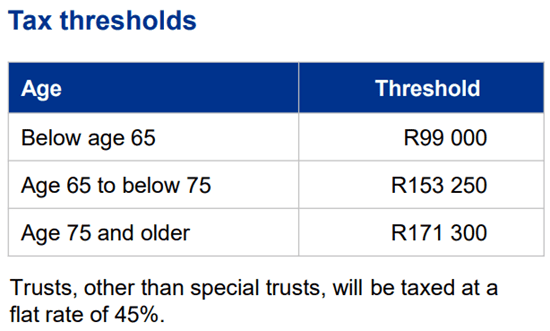
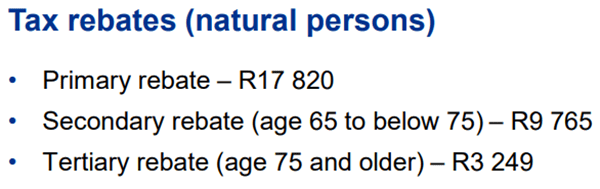
Learn the 2027 individual tax rates, thresholds and rebates in South Africa and who is required to submit a tax return.
Understanding the latest individual tax rates, thresholds and rebates in South Africa is essential for managing your personal tax position and ensuring compliance with SARS requirements.
These rates determine how much tax you pay and whether you are required to submit a tax return.
2027 Tax Year Overview
The 2027 tax year covers the period ending 28 February 2027. SARS publishes updated tax rates, thresholds and rebates annually as part of the National Budget.
Staying informed of these updates helps you plan ahead and avoid unexpected tax liabilities.
Who Needs to Submit a Tax Return?
Not all individuals are required to submit a tax return each year. The South African Revenue Service (SARS) issues annual guidelines outlining who must file based on income levels and other criteria.
It is important to review these requirements each year to ensure that you remain fully compliant.
Individuals Required to Submit Tax Returns
The Commissioner publishes an annual public notice specifying which individuals are required to submit tax returns for normal tax purposes.
The relevant Government Gazette for the tax year ended 28 February 2026 is expected to be issued between May and July 2026.
These official notices provide detailed criteria for determining whether a tax return must be submitted.
Where to Find Official SARS Notices
You can access the latest public notices and tax requirements directly from SARS:
Understanding tax rates, thresholds and filing requirements is key to managing your personal tax obligations effectively.
If you are unsure whether you need to submit a return or how the latest tax updates affect you, professional guidance can help ensure that you remain compliant and well prepared.
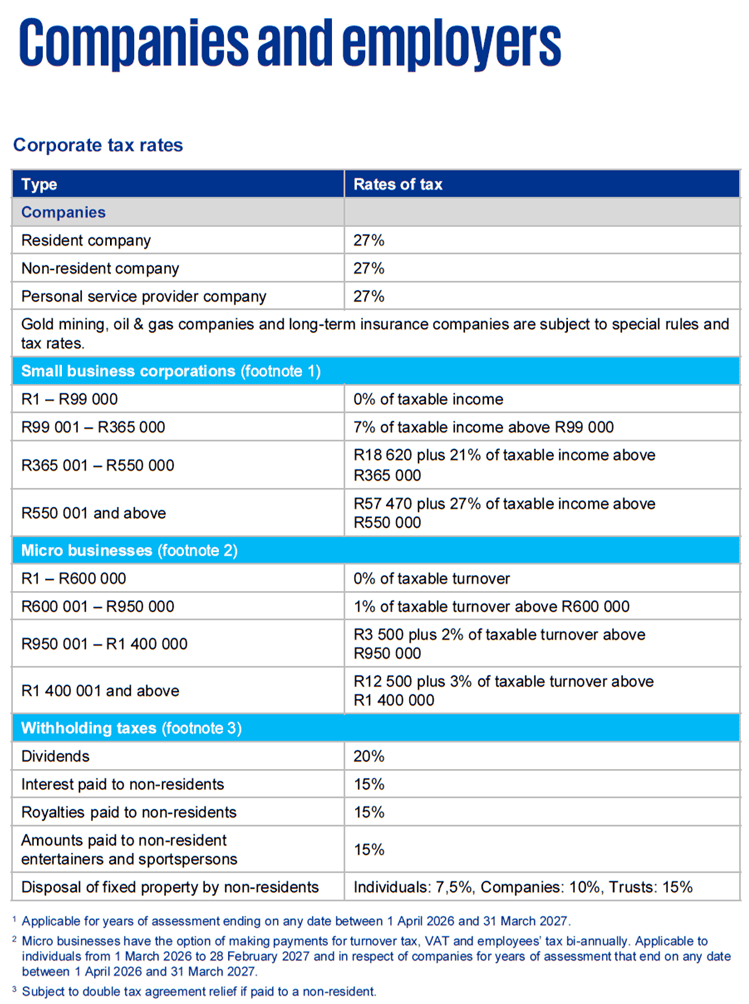
Understanding corporate tax rates in South Africa is essential for effective financial planning and compliance. Different business structures are taxed differently, including standard companies, small business corporations (SBCs) and turnover tax for micro businesses.
Knowing which regime applies to your business helps ensure accurate tax planning and compliance with SARS requirements.
Standard Company Tax Rate
The standard corporate income tax rate in South Africa is:
27% for companies
This rate applies to most companies and is calculated on taxable income after allowable deductions.
Small Business Corporation (SBC) Tax Rates
Small Business Corporations benefit from a progressive tax system, which means lower rates apply to smaller taxable income levels.
To qualify as an SBC, a business must meet specific SARS criteria, including turnover limits and shareholder requirements.
SBC tax rates are applied on a sliding scale, allowing smaller businesses to pay reduced tax compared to standard company rates.
Turnover Tax for Micro Businesses
Turnover tax is a simplified tax system designed for micro businesses with a qualifying turnover below a specified threshold.
This system replaces multiple taxes with a single tax based on turnover, making compliance easier for smaller businesses.
Turnover tax is calculated on a progressive scale, depending on total annual turnover.
Choosing the Right Tax Structure
Each tax regime has different implications for your business, depending on factors such as turnover, structure and operational complexity.
Understanding these differences is important to ensure that your business is structured in a tax-efficient and compliant manner.
Final Thoughts
Corporate tax rates and structures can have a significant impact on your business’s financial position.
If you are unsure which tax regime applies to your business or need assistance with compliance and planning, professional guidance can help ensure that your obligations are managed correctly.
Learn how Capital Gains Tax works in South Africa for individuals, companies and trusts and how it affects your taxable income.
Capital Gains Tax (CGT) in South Africa applies when you dispose of an asset such as property, shares or investments. Understanding how CGT works is essential for effective financial planning and avoiding unexpected tax liabilities.
This guide provides a clear overview of how Capital Gains Tax applies to individuals, companies and trusts and how it affects your taxable income.
What is Capital Gains Tax?
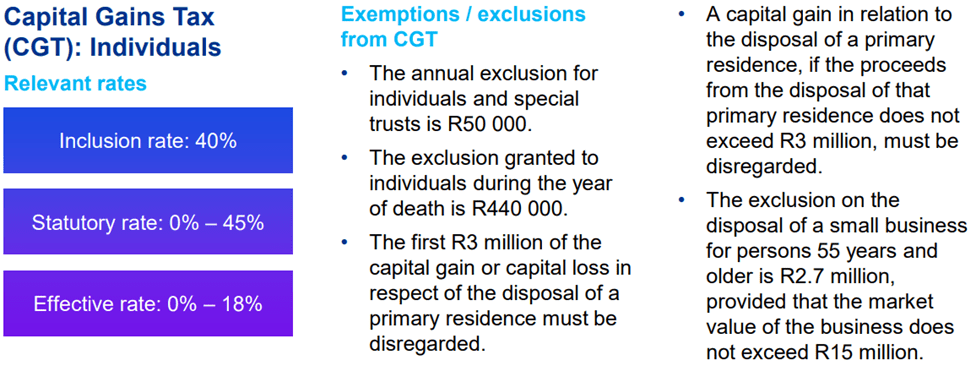
Capital Gains Tax is not a separate tax, but forms part of your income tax. When you dispose of an asset, a portion of the capital gain is included in your taxable income and taxed accordingly.
The amount of tax payable depends on the type of taxpayer and the applicable inclusion rate.
Capital Gains Tax – Individuals
For individuals, Capital Gains Tax applies when personal or investment assets are sold or disposed of.
A portion of the capital gain is included in taxable income
The gain is taxed at the individual’s marginal tax rate
Capital Gains Tax also applies at death, where assets are deemed to be disposed of at market value. This can have a significant impact on a deceased estate and should be considered as part of estate planning.
Companies are subject to Capital Gains Tax at a fixed inclusion rate.
A portion of the capital gain is included in company taxable income
The taxable amount is then taxed at the standard corporate tax rate
Capital Gains Tax for Trusts
Trusts are subject to a higher inclusion rate, which generally results in a higher effective tax burden.
Capital gains may be distributed to beneficiaries
This can allow for potential tax efficiency depending on the structure
Capital Gains Tax also applies at death, where assets are treated as disposed of at market value. This can have a significant impact on a deceased estate.
Why Capital Gains Tax Matters
Capital Gains Tax can significantly impact the proceeds from the sale of assets. Proper planning can help reduce tax exposure and ensure compliance with SARS requirements.
Understanding how CGT applies to different entities allows for better financial decision-making and long-term planning.
Final Thoughts
Capital Gains Tax plays an important role in overall tax planning for individuals, businesses and trusts.
If you are planning to dispose of assets or need assistance understanding how CGT affects your tax position, professional guidance can help ensure accurate calculations and compliance.
Business compliance in South Africa is essential for ensuring that companies meet their legal, regulatory and tax obligations. These requirements are set by SARS and other regulatory bodies and must be maintained consistently to avoid risk.
Staying compliant not only protects your business from penalties and legal issues, but also strengthens credibility with clients, suppliers and financial institutions.
What is Business Compliance?
Business compliance refers to meeting all statutory and regulatory requirements applicable to your business. This includes tax compliance, company filings and adherence to relevant legislation.
Maintaining compliance ensures that your business operates within the legal framework and remains in good standing with regulatory authorities.
Risks of Non-Compliance
Failure to maintain proper compliance can result in serious consequences, including:
Financial penalties and administrative fines
Deregistration of the company
Delays in banking, funding or tender applications
Increased legal and tax risk
These risks can impact both the financial position of the business and its long-term sustainability.
Why Compliance Supports Business Growth
Proactive compliance does more than just avoid penalties. It creates a stable and trustworthy foundation for business operations.
A compliant business is more likely to:
Build credibility and trust with stakeholders
Access funding and financial support more easily
Qualify for tenders and business opportunities
Make informed and confident financial decisions
Final Thoughts
Business compliance is not just a legal requirement, but a key part of building a sustainable and successful business.
Ensuring that your compliance obligations are properly managed helps protect your business, supports growth and provides peace of mind.
If you need assistance managing your compliance requirements, professional support can help ensure that everything is handled accurately and efficiently.
We use cookies to ensure our website functions optimally and to enhance your browsing experience. By continuing, you agree to our use of cookies. Learn more in our Cookie Notice.
Functional
Always active
The technical storage or access is strictly necessary for the legitimate purpose of enabling the use of a specific service explicitly requested by the subscriber or user, or for the sole purpose of carrying out the transmission of a communication over an electronic communications network.
Preferences
The technical storage or access is necessary for the legitimate purpose of storing preferences that are not requested by the subscriber or user.
Statistics
The technical storage or access that is used exclusively for statistical purposes.The technical storage or access that is used exclusively for anonymous statistical purposes. Without a subpoena, voluntary compliance on the part of your Internet Service Provider, or additional records from a third party, information stored or retrieved for this purpose alone cannot usually be used to identify you.
Marketing
The technical storage or access is required to create user profiles to send advertising, or to track the user on a website or across several websites for similar marketing purposes.