

Learn how provisional tax works in South Africa, including deadlines, penalties and the latest 2026 SARS updates on underestimation rules.
Provisional tax is an important part of the South African tax system for individuals and businesses earning income outside of a traditional salary. Understanding how it works, including deadlines and penalties, is essential to remain compliant with SARS requirements.
What is Provisional Tax?
Provisional tax applies to individuals who earn income other than a salary or standard remuneration from an employer. This includes income such as rental income, interest or income from a trade or small business.
If you earn non-salary income, you may be required to register as a provisional taxpayer, even if you also earn a salary.
Provisional tax is paid manually in advance, based on estimated taxable income for the year.
Provisional Tax Deadlines
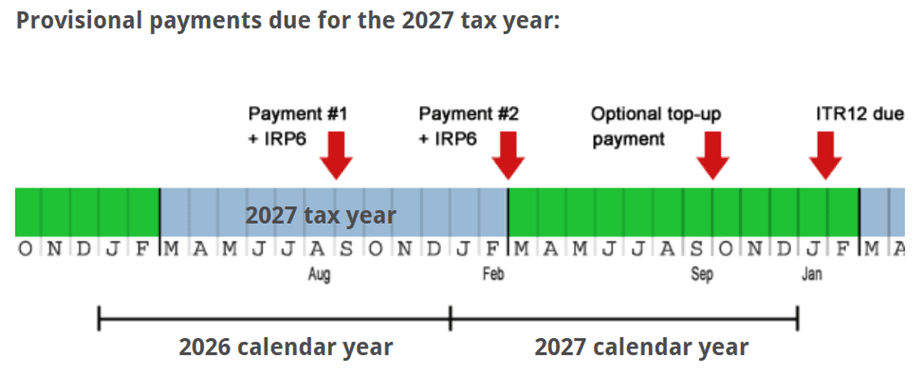
Provisional tax is paid in two compulsory instalments each year:
First payment
Due by the end of August (mid tax year)
Second payment
Due by the end of February (end of tax year)
Optional third payment
Due by the end of September (seven months after the end of the tax year)
This payment is only required if the first two payments were insufficient
Penalties for Late Payment and Underestimation
SARS may impose penalties in the following circumstances:
Late payment penalty
A 10 percent penalty is charged on any late payment of provisional tax
Underestimation penalty
A 20 percent penalty is charged if the estimated taxable income is significantly lower than the final assessed taxable income
With effect from 25 February 2026, failure to pay the estimated amount on time may also trigger the underestimation penalty
The 20 percent underestimation penalty is reduced by any late payment penalty already imposed. These penalties are applied in terms of section 213 of the Tax Administration Act
When Does the Underestimation Penalty Apply?
The underestimation penalty applies in the following cases:
For taxable income below R1 million
If the estimate is less than 90 percent of the final assessed taxable income and less than the basic amount based on the most recent assessment
For taxable income above R1 million
If the estimate is less than 80 percent of the final assessed taxable income
2026 Update to Threshold
From 1 March 2026, the threshold for relying on historical assessed income increases from R1 million to R1.8 million
This change affects how taxpayers calculate their provisional tax estimates and may reduce the risk of underestimation penalties for certain taxpayers
Final Thoughts
Provisional tax requires careful planning and accurate estimation to avoid penalties and ensure compliance with SARS requirements
If you are unsure about your provisional tax obligations or need assistance with calculations and submissions, professional guidance can help you stay compliant and avoid unnecessary penalties