

Learn how Capital Gains Tax works in South Africa for individuals, companies and trusts and how it affects your taxable income.
Capital Gains Tax (CGT) in South Africa applies when you dispose of an asset such as property, shares or investments. Understanding how CGT works is essential for effective financial planning and avoiding unexpected tax liabilities.
This guide provides a clear overview of how Capital Gains Tax applies to individuals, companies and trusts and how it affects your taxable income.
What is Capital Gains Tax?
Capital Gains Tax is not a separate tax, but forms part of your income tax. When you dispose of an asset, a portion of the capital gain is included in your taxable income and taxed accordingly.
The amount of tax payable depends on the type of taxpayer and the applicable inclusion rate.
Capital Gains Tax – Individuals
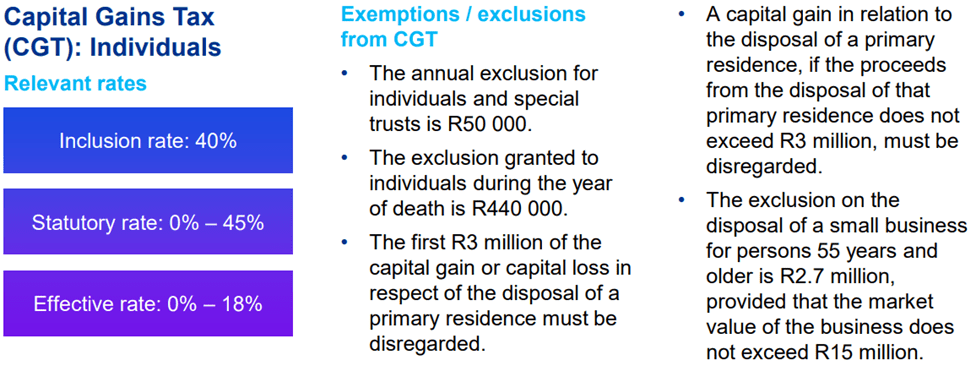
For individuals, Capital Gains Tax applies when personal or investment assets are sold or disposed of.
- A portion of the capital gain is included in taxable income
- The gain is taxed at the individual’s marginal tax rate
Capital Gains Tax also applies at death, where assets are deemed to be disposed of at market value. This can have a significant impact on a deceased estate and should be considered as part of estate planning.
Learn more about the deceased estate tax workflow
Capital Gains Tax for Companies
Companies are subject to Capital Gains Tax at a fixed inclusion rate.
- A portion of the capital gain is included in company taxable income
- The taxable amount is then taxed at the standard corporate tax rate
Capital Gains Tax for Trusts
Trusts are subject to a higher inclusion rate, which generally results in a higher effective tax burden.
- Capital gains may be distributed to beneficiaries
- This can allow for potential tax efficiency depending on the structure

Capital Gains Tax also applies at death, where assets are treated as disposed of at market value. This can have a significant impact on a deceased estate.
Why Capital Gains Tax Matters
Capital Gains Tax can significantly impact the proceeds from the sale of assets. Proper planning can help reduce tax exposure and ensure compliance with SARS requirements.
Understanding how CGT applies to different entities allows for better financial decision-making and long-term planning.
Final Thoughts
Capital Gains Tax plays an important role in overall tax planning for individuals, businesses and trusts.
If you are planning to dispose of assets or need assistance understanding how CGT affects your tax position, professional guidance can help ensure accurate calculations and compliance.